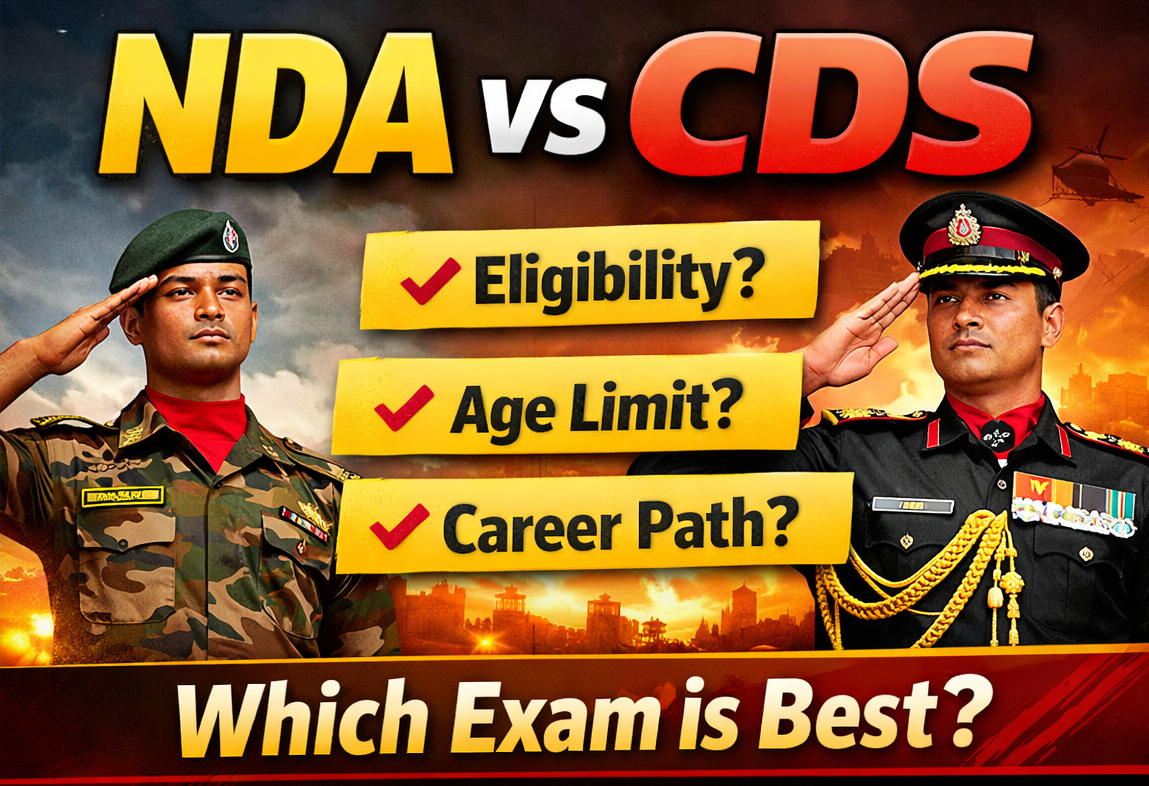
NDA vs CDS: Eligibility, Age Limit, Exam Pattern & Which Defence Exam Is Best for You?
NDA vs CDS: Eligibility, age limit & exam comparison.
Last update:
13-01-2026 12:07 PM
Defence (NDA vs CDS): Complete Guide to Joining India’s Armed Forces
Joining the Indian Armed Forces as an officer is a dream for many young aspirants. The two primary entry paths for becoming a commissioned officer through UPSC are National Defence Academy (NDA) and Combined Defence Services (CDS). Both exams are conducted by the Union Public Service Commission (UPSC) and offer entry into the Indian Army, Navy, and Air Force.
While both lead to a prestigious defence career, NDA and CDS differ in eligibility, age limit, training structure, and career entry point. This blog explains everything in detail to help you choose the right path.
What is NDA (National Defence Academy)?
The National Defence Academy (NDA) is meant for students who wish to join the defence forces immediately after Class 12 (10+2). It offers early entry into the armed forces with integrated academic and military training.
NDA Eligibility Criteria
Educational Qualification:
Passed 10+2
Physics & Mathematics required for Air Force and Navy
Age Limit:
16.5 to 19.5 years
Gender:
Both male and female candidates are eligible
NDA Training Process
3 years training at NDA, Pune (Integrated degree + military training)
1 year specialized training at:
Indian Military Academy (IMA)
Indian Naval Academy (INA)
Air Force Academy (AFA)
Best For
Students who want to start their defence career immediately after school
Aspirants who want early exposure to military life
Those aiming for long-term career growth and faster promotions
What is CDS (Combined Defence Services)?
The Combined Defence Services (CDS) exam is designed for graduates who want to join the armed forces as officers after completing their college education.
CDS Eligibility Criteria
Educational Qualification:
Graduate degree from a recognized university
Age Limit:
Approximately 19 to 25 years (varies by academy)
Gender:
Both male and female candidates are eligible
CDS Training Process
Direct entry into respective academies:
IMA (Army)
INA (Navy)
AFA (Air Force)
OTA (Short Service Commission)
Training duration is shorter compared to NDA
Best For
Graduates seeking an officer’s commission
Aspirants who want to complete graduation first
Candidates looking for direct service academy training
Key Differences Between NDA and CDS
Feature
NDA
CDS
Entry Point
After 10+2
After Graduation
Age Limit
16.5 – 19.5 years
19 – 25 years
Training Style
Degree + military training together
Only military training
Exam Pattern
Maths + GAT
English + GK + Maths
Career Start
Earlier
Slightly later
Promotion Advantage
Faster due to early entry
Standard progression
NDA vs CDS: Exam Pattern Overview
NDA Exam Pattern
Mathematics
General Ability Test (GAT) (English, GK, Science, History, Geography, Current Affairs)
CDS Exam Pattern
English
General Knowledge
Mathematics (except OTA)
How to Choose Between NDA and CDS?
Choose NDA If:
You want to join the armed forces right after school
You want to earn a degree while training
You aim for a longer service career with faster promotions
You are within the 16.5–19.5 age range
Choose CDS If:
You prefer to complete graduation first
You want direct entry into service academies
You are looking for shorter training duration
You missed NDA or decided later to join defence services
Conclusion
Both NDA and CDS are prestigious gateways to becoming an officer in the Indian Armed Forces. The right choice depends on your age, educational qualification, and career planning.
NDA is ideal for young aspirants who want an early and long-term defence career.
CDS is best for graduates who want to join the forces after college with focused training.
No matter which path you choose, dedication, discipline, and determination are the keys to success in defence exams 🇮🇳✨
 NDA vs CDS: Eligibility, Age Limit, Exam Pattern & Which Defence Exam Is Best for You?